Superabrasives are defined by their extreme hardness and crystalline stability. Selecting the optimal grain type is essential to maintain structural integrity, control thermal generation, and maximize wheel utility during high-precision industrial processing.
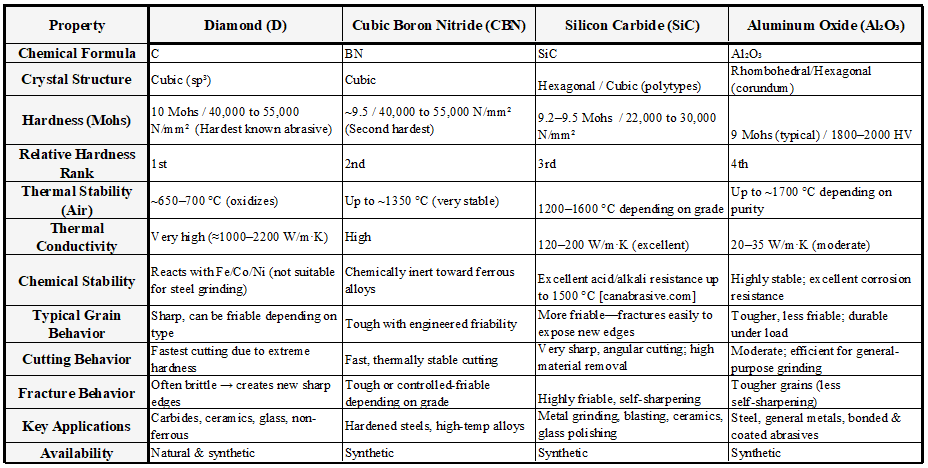
ABRASIVES CHARACTERISTICS COMPARISON
From a materials‑engineering s tand point Diamond remains the hardest known abrasive, giving superior cutting efficiency. While CBN, slightly less hard, provides significantly higher thermal stability, owing to its:
These distinctions make Diamond the preferred choice for non‑ferrous, carbide, and ceramic materials, while CBN is the optimal abrasive for hardened steels and high‑temperature alloys. Both Diamond and CBN abrasive grains exhibit several critical grain‑engineering characteristics
Diamond Superabrasive (D)
Diamond superabrasives Tools offer an exceptional hardness, enabling superior precision, surface quality, and tool life. They are optimized for processing tungsten carbide, technical ceramics, sapphire, quartz, glass, and advanced composite materials. However, when applied to ferrous materials at high temperatures, carbon migration can accelerate tool wear, limiting their suitability for iron-based alloys.
Extreme hardness: Knoop ~8000 HK
High thermal stability up to 700°C
Critical for non-ferrous and non-metal grinding
Cubic Boron Nitride (CBN)
The second hardest known material, offering immense thermal threshold stability (up to 1,400°C). Unlike diamond, CBN is highly inert to iron and oxidation. It is the premier choice for hardened tool steels, alloy steels, cast iron, and nickel-based superalloys, maintaining sharp cutting profiles without thermal degradation.
Exceptional thermal stability up to 1400°C
Chemically inert to iron-group metals
Optimized for hardened steels and alloy components
CONVENTIONAL ALUMINA & SiC
Conventional Alumina and Silicon Carbide abrasives provide dependable grinding performance across diverse manufacturing environments. Engineered with durable macro-crystalline grain structures, these abrasives combine high material-removal rates, process reliability, and cost efficiency. They are widely used for machining iron-based alloys, cast iron, non-ferrous metals, composites, and other low-tensile-strength materials where robust cutting action and operational flexibility are required.
High stock-removal capability for general-purpose grinding applications
Versatile performance across ferrous, non-ferrous, and cast materials
Cost-effective solution for roughing, surface grinding, and finishing operations
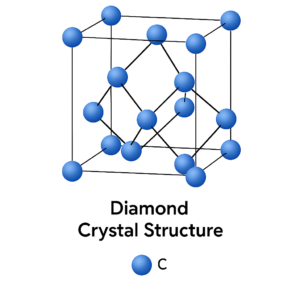
DIAMOND CRYSTAL STRUCTURE
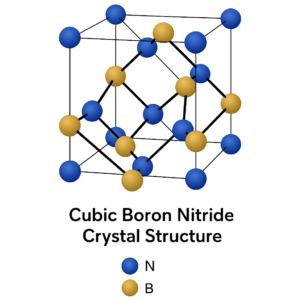
C.B.N CRYSTAL STRUCTURE
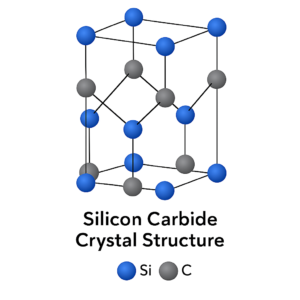
SILICON CARBIDE STRUCTURE
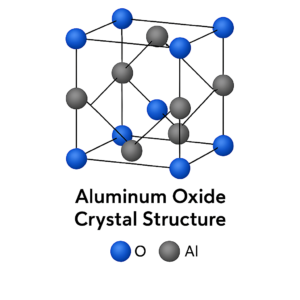
ALUMINUM OXIDE STRUCTURE
[MANUAL PDF LINK PLACEHOLDER – ADD FILE HERE]
ABRASIVE GRIT SIZES COMPRASION
Abrasive grit size defines particle size and impacts cutting, finish, and tool life.
FEPA, ANSI, and JIS standards classify grain sizes globally.
Diamond and CBN abrasive grit sizes are classified according to internationally recognized FEPA and ANSI standards, each employing a different grading methodology. The FEPA (Federation of European Producers of Abrasives) “D” and “B” standards define abrasive grain sizes based on precise micron ranges, ensuring consistent particle size distribution and process control. In contrast, the ANSI (American National Standards Institute) system classifies abrasives according to mesh size, which corresponds to the number of wire screenopeningsperlinearinch.Understandingtherelationshipbetweenthesestandardsisessentialwhenspecifyingsuperabrasiveproducts,asequivalentgritdesignationsmaydiffersignificantlybetweengradingsystems.
In technical grinding applications, understanding these core equivalencies is critical to predicting surface roughness (Ra) and material removal rates. This matrix outlines primary abrasive specifications commonly deployed across global high-tolerance manufacturing.
Grade Classification
FEPA (Europe)
ANSI (US)
Avg. Micron (µm)
Very Coarse
D1000
18
1000 µm
Coarse
D181
80
175 µm
Medium
D64
230
62 µm
Fine
D30
500
30 µm
Very Fine
D15
1200
15 µm
Ultra Fine
D5
3000
5 µm
DIAMOND FEPA STANDARD
C.B.N FEPA STANDARD
US (ANSI MESH)
MEAN MICRON
D3
B3
5000
2-4 µm
D5
B5
3000
4-8 µm
D10
B10
1600
5-15 µm
D15
B15
1200
15-25 µm
D20
B20
1000
10-20 µm
D30
B30
500 / 600
25-32 µm
D35
B35
400 / 500
32-40 µm
D46
B46
325 / 400
38-45 µm
D54
B54
270 / 325
45-53 µm
D64
B64
230 / 270
53-64 µm
D76
B76
200 / 230
63-76 µm
D91
B91
170 / 200
75-90 µm
D107
B107
140 / 170
90-106 µm
D126
B126
120 / 140
106-125 µm
D151
B151
100 / 120
125-150 µm
D181
B181
80 / 100
150-180µm
D252
B252
60 / 80
212-250µm
D426
B426
40 / 45
355-425µm
D711
B711
25 / 30
600-710µm
D851
B851
20 / 25
710-850µm
D1001
B1001
18 / 20
850-1000µm
D1200
B
16/ 18
1200µm
[MANUAL PDF LINK PLACEHOLDER - ADD FILE HERE]
SUPER ABRASIVES CONCENTRATION
Technical correlation matrix showing the standard relationship between concentration, volume percentage, and density.
formulating the guideline for Diamond & CBN wheel optimization.
Abrasive concentration is defined as the normalized volumetric loading of superabrasive grains within the working layer of a bonded diamond or CBN tool. Diamond concentration use the letter ‘C’, C100 equals 4.4 ct/cm³ (25 vol.% abrasive phase), CBN concentrations use the letter ‘V’, V240, equals 24 vol.% abrasive volumebased concentrations expressed in parts per thousand. Concentration selection determines active cutting edge frequency, inter-grain spacing, stress distribution within the bond matrix, thermal transport efficiency, grinding force characteristics, wheel wear kinetics, and process stability.
Concentration Impacts Wheel Wear
Abrasive concentration directly affects the number of active cutting grains available in the grinding zone.
Higher concentration generally decreases wheel wear by increasing cutting-point density and distributing grinding forces across more abrasive grains. Lower concentration increases grain loading, leading to accelerated abrasive and bond wear.
Concentration Affects Heat Dissipation
Abrasive concentration influences heat generation and heat transfer in two competing ways.
Concentration affects thermal behavior through a balance between cutting-point density and wheel porosity. Increasing concentration generally lowers heat generation per grain and improves thermal conductivity, while excessive concentration may restrict coolant flow and chip evacuation, potentially increasing grinding temperatures.
C.B.N CONCENTRATIONS
Concentration Code
Volume %
V60
6
V90
9
V120
12
V180
18
V240
24
V300
30
V360
36
DIAMOND CONCENTRATIONS
Concentration Code
Carats / cm³
Carats / in³
Primary Application Suitability
C25
6.25
1.1
Open grain structure for freer cutting action, lower grinding forces, and improved swarf evacuation.
C38
9.5
1.65
Open grain structure for freer cutting action, lower grinding forces, and improved swarf evacuation.
C50
12.5
2.08
Large contact areas, ultra-fine finishes, minimal thermal load.
C75
18.75
3.13
Standard wet grinding, general purpose tool room applications.
C100
25
4.17
Highly versatile default, optimal balance of lifetime and cut rate.
C125
31.25
5.22
Profile preservation, heavy cycle rates, narrow wheel profiles.
C150
37.55
6.26
High cutting-point density, exceptional profile retention, extended wheel life.
C175
43.75
7.7
Ultra-high grain density, maximum profile stability, exceptional wheel longevity.
[MANUAL PDF LINK PLACEHOLDER - ADD FILE HERE]
Technical Documentation
Access complete specifications, dimensional drawings, and compliance materials. Click below to view the technical PDF directly in your browser.