PRODUCT FAMILIES
A ONE INDUSTRIAL offers a wide portfolio of tools and grinding wheels available in virity of Grit/Bond matrices to meet Customer’s application needs. Each product is engineered with premium grade abrasive grains/concentration to ensuring our customers reliable, high efficiency solutions designed to improve output quality and strengthen their competitive edge.
Resin Bond Family
Large selection of resin-bond tools, with bond systems
designed for the most common operations in tool
manufacturing, sharpening, profiling, surface grinding, and
both inner- and outer-diameter grinding applications.
Our resin-bond superabrasive wheels available with diamond
or CBN provide fast, cool cutting performance.
The bond matrix is available in two primary classes based on
strength and temperature resistance: phenolic and polyimide
resins.
These binders engineered to ensur stability, durability, and
high precision across a wide range of grinding processes.
Diamond wheels deliver exceptional performance across a
wide range of demanding grinding applications such as
carbides, cermets, ceramics, graphite, precious glass, sintered
materials and many others.
While CBN wheels are designed for grinding hardened steels,
cast iron, satellites, nickel alloys for high temperatures and
verity automotive applications Diamond the preferred choice for non‑ferrous, carbide, and ceramic materials, while CBN is the optimal abrasive for hardened steels and high‑temperature alloys.
Both Diamond and CBN abrasive grains exhibit several critical grain‑engineering characteristics.
Hybrid Bond Tools
Hybrid-bond superabrasive grinding wheels available with diamond or cubic boron nitride (CBN) are specially engineered for creep-feed grinding applications that require high feed rates and deep cuts on modern CNC grinding machines. Featuring a more porous bond structure, hybrid wheels generate lower grinding pressure and significantly reduce heat buildup. They also provide superior wear resistance and are less sensitive to impact forces compared to traditional resin-bond tools.
Although hybrid bonds are not typically used for extremely high material-removal rates like resin bonds, they offer an excellent balance of strength, durability, and cutting efficiency. Hybrid bond Diamond wheels are commonly used for CNC grinding of carbide and advanced ceramics,
while CBN hybrid wheels are typically used for CNC
grinding of high-speed steel (HSS), stainless steel, and other hardened tool steels.
Metal Bond Tools
Metal bond superabrasive grinding tools are significantly
more wear resistant and less sensitive to impact forces than resin bond tools. This advantage is due to the higher
mechanical strength of the metal bond matrix, which is
typically combined with tougher, blocky grit types designed
for this bonding system.
However, metal bond tools are generally not used for high
material removal rates, as resin bond tools are more suitable for aggressive grinding applications. Metal bonded grinding tools are the preferred solution for applications requiring high corner retention and precise profiling. Metal bond grinding wheels operate at a slower grinding rate and tend to generate more heat. For this reason, they are primarily recommended for wet grinding operations, where effective cooling can be applied.
Metal bond diamond grinding tools are commonly used in
CNC grinding and machining of non metallic materials,
including ceramics, glass, carbides, ferrites, stone, quartz,
concrete and dressing vitrified (VIT) wheels.
Electroplated Bond Tools
Electroplated bonds consist of a single layer of diamond or
CBN abrasive grit securely encapsulated in a nickel plating
deposited onto a steel substrate through an electrolytic process. This construction allows maximum grain protrusion, delivering exceptional cutting performance and very high material removal rates, even on the hardest materials.
Electroplated tools are ideal for applications requiring critical
form accuracy and complex profiles, as they are manufactured exactly to customer specified geometries and typically require no dressing during their service life. A key economic advantage of electroplated wheels is their ability to be stripped and re plated, offering cost savings of up to 30% compared to purchasing new tools,electroplated tools
can be easily maintained by cleaning with a brush or abrasive stick. Electroplated bond technology supports a wide range of designs, including continuous and segmented rims, and extends beyond wheels to tools such as files, dressers, blocks, spindles, drivers, and dermatology instruments Elctroplated bond grinding tools are commonly used in CNC grinding and machining of Gears and complex aerospace components,Tungsten carbide,Stainless steel and high speed
steel (HSS), Ductile and cast irons, High temperature alloys
(including Inconel),Composites, fiberglass, ceramics, and glass.
Vitrified Bond Tools
Vitrified bond superabrasive wheels are engineered using a
refined blend of clay, kaolin, feldspar, and glass like frits or
recrystallized glasses, delivering a bond system that is more
free cutting than metal bond wheels while maintaining
excellent form control and stability.
Controlled bond porosity ensures low heat generation,
efficient coolant penetration, and outstanding profiling
capability, particularly in demanding form grinding operations.
Vitrified bonded tools are especially well suited for automatic
and CNC grinding machines, where their easy dressability,
consistent cutting behavior, and profile retention are critical.
Advances in grinding machine technology have made vitrified
bonds a rapidly growing wheel family, enabling higher
grinding speeds, increased precision, and excellent material
removal rates. Modern vitrified wheels can operate at speeds
of up to 140 m/s while maintaining high dimensional accuracy
and profile stability.
All vitrified superabrasive wheels can be dressed directly on
the machine, in the same manner as conventional abrasive
wheels, providing flexibility and reduced setup times. Typical
Applications for vitrified superabrasive wheels
- Diamond wheels: Grinding of carbide, ceramics, CVD, PCD, and metal matrix composites
- CBN wheels: Grinding of hardened steels, tool steels, and superalloys, including cylindrical grinding, automotive powertrain and bearing components, aircraft engine parts, and power turbine components
Resin Bond characteristics:
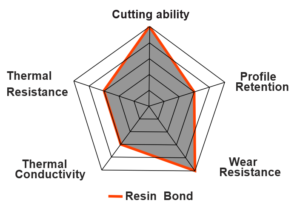
High stock-removal capability for general-purpose grinding applications
soft nature of cutting action
low temperature resistance due to good grip and
Free cutting
Cool grinding at high feed rates and with high material
removal volumes
Dry and wet applications possible
Long lifetime
Excellent performance
Hybrid Bond characteristics
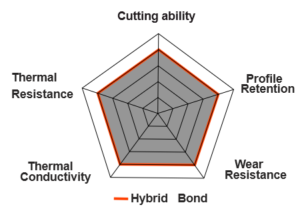
High mechanical strength
Thermally resistant
High wear resistance
High tool life
Higher grinding forces
Higher profile and edge retention
Primarily wet grinding
Metal Bond characteristics:
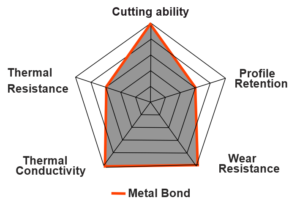
High mechanical strength
Excellent thermal resilience
Superior wear resistance
Excellent profile and edge retention
Higher grinding forces
Primarily wet grinding
Hard to dress
Elctroplated Bond characteristics:
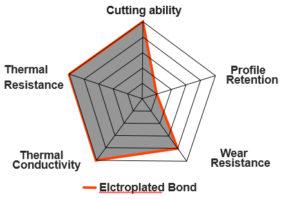
Very high material removal rates
Maximum abrasive exposure for
aggressive cutting.
High precision and excellent form resistance
No dressing required
Strip and replate capability for lower lifecycle
costs
Suitable for complex profiles and small tool
dimensions
Vitrified Bond characteristics:
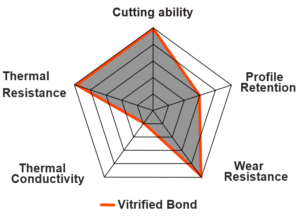
Free cutting behavior with high profile
stability
Low heat generation due to controlled
porosity
Suitable for high speed, high precision
CNC grinding
In process and on machine dressable
Excellent performance
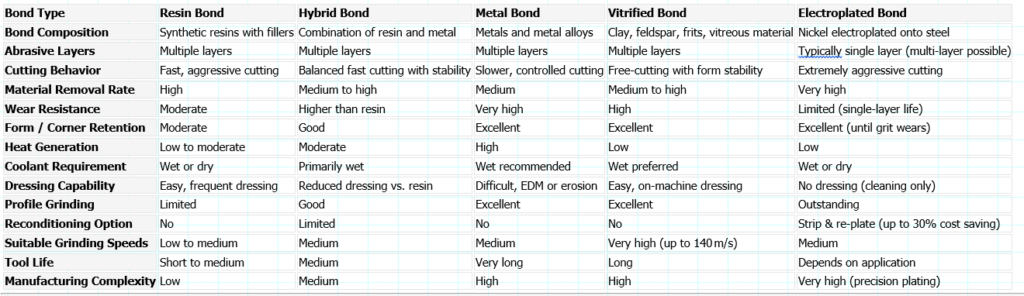
Superabrasive Bond Systems Comparison Overview